Modern Methods of Construction (or MMC) is constantly being redefined with the creation of new production styles and platforms designed for speed and ease of assembly, reducing material use and wastage, and, in many circumstances, relying less on skilled trades and traditional construction techniques. But it doesn’t stop there, the aim of achieving more consistent quality or tighter tolerances is also taken into consideration making sure that the speed of construction doesn’t impair the quality of the build.


Modern Methods of Construction (MMC)
Common types of MMC

Volumetric systems
A volumetric approach to MMC is the supply of complete modules, or pods, delivered to site, craned into position and joined together. They are often highly finished, especially internally – there are examples of hotel room modules delivered to site containing a made bed.
The module size is constrained by what will fit on a lorry, and they typically need finishing externally once installed.

Loadbearing and infill panels
Panels designed as loadbearing elements can remove some of the risk associated with setting out and tolerances, though still depend on accuracy when preparing the foundations. Where a project requires a structural frame, then lightweight infill panels can be supplied to site fully complete. For a steel frame with good tolerances, installing an infill panel that includes the rendered finish is feasible. The joints in the panels can be finished using gaskets and seals, ensuring a consistent and high-quality finish without any rendering needing to be done onsite.

Structural insulated panels (SIPS)
SIPs are another form of loadbearing panel. They differ from the previous option as the finish is likely to be applied directly to the outer timber skin of the SIP, which is not desirable where render is concerned. Timber moves with changing moisture content, resulting in debonding and cracking of the render. Use of an approved render carrier board, supported on the external face of the SIP, rather than applying render directly to the timber is more sympathetic to the needs of the finish.
Render solutions for Modern Methods of Construction

Flexibility is key
Modern Methods of Construction (MMC) solutions are predominantly based around a frame system which are inherently flexible so the render system also needs some flexibility.
The best way to achieve this is through the application of thin polymer-modified layers. As a result, a typical MMC render system is based around a render carrier board, to which a polymer-modified base coat is applied. This is applied in two passes with a reinforcement mesh between. Once the base coat is complete, a thin decorative finish can be applied.
The high performance weberend MT multi-coat render system was applied as the exterior finish on the new-build Woodward Close, a pioneering 60-bed dementia care home in Winnersh, Berkshire.

weberend MT
This multi-coat render system is designed for application on to an appropriately-framed and boarded panel background, with a choice of textured finishes in a wide range of colours. It offers a high degree of weather protection, crack resistance and fire performance.
The system’s base coat is weberend LAC rapid which is polymer-modified, which helps it to retain some flexibility. As well as drying quickly, it doesn’t require priming, which makes for faster installation. Mesh reinforcement between the two base coat layers provides extra impact resistance.
The render system can be finished with webersil TF light textured finish or weberwall brick an authentic brick effect system.
External Wall Insulation solutions for Modern Methods of Construction

Simplify wall construction with EWI
When improved thermal performance and additional layers of insulation are required, a render-coated external wall insulation (EWI) system can be specified without encroaching on internal space.
EWI is ideal for frame structures as it simplifies wall construction, is lightweight and delivers great thermal efficiency with narrower walls.
Similar to a multi-coat render system, webertherm XM uses weberend LAC rapid as a polymer-modified base render coat with meshcloth reinforcement but is applied to an insulation board before being finished with a wide selection of decorative finishes.
The Hale Village regeneration project, one of the largest schemes in London, was built using modular construction techniques linked on-site into shared flats. The modules were insulated on-site with the application of the webertherm XM EWI system which was specified along with weberplast TF, a decorative, protective, low-maintenance render finish.

webertherm XM
Similar to a multi-coat render system, webertherm XM uses weberend LAC rapid as a polymer-modified base render coat with meshcloth reinforcement but is applied to an insulation board. The system improves thermal performance and internal comfort and is available in a wide range of coloured textured finishes and brick-effect finishes and is suitable for most building types including frame-built structures.
The webertherm XM panel silicone system (MFD) uses non-combustible mineral fibre insulation and achieves a reaction to fire classification of A2-s1,d0 which means it is suitable for use on buildings above 11 metres.
What's more the system comes fully BBA-approved, and can be finished in a range of over 100 coloured decorative finishes or 12 authentic brick-effect styles.

We're here to support your next MMC project
With a range of support services designed to help you specify the right solutions for your next MMC project including a national applications team which offers onsite support and training, as well as a RIBA-approved CPD.
Choosing a final façade finish

Synthetic decorative finish
Synthetic decorative finishes can cater to both modern and traditional building designs, and offer great weather resistance and choice of available colours.
The ideal choice is webersil TF, a textured silicone render finish used as a highly weather-resistant decorative coating. The 1.5mm aggregate content provides a modern even textured finish:
- Available in over 100 colour choices
- Highly water repellent, providing optimum façade protection
- Highly vapour permeable
- Weather resistant and UV stable
- Low susceptibility to soiling
- Hand or spray applied
Used as the final finish for the weberend MT panel silicone system or the webertherm XM panel silicone system (MFD), these systems each benefit from:
- A2-s1,d0 reaction to fire classification in accordance with BS EN 13501
- Approval from the British Board of Agrément (BBA)

Brick-effect
Dominating UK construction for years, bricks and mortar are still popular in a time where advanced modern construction methods are being adopted. Sometimes, this is not only a stylistic preference but planning stipulations may require a building has a brickwork appearance regardless of its underlying structure.
weberwall brick finish is a lightweight, brick-effect finish which can be installed in a fraction of the time when compared to traditional brick slips:
- Available in a range of 12 popular brick styles
- Formulated with 95% minerals bound in cross-linked polymers laid onto a mesh sheet, this is a fully flexible and colourfast system that allows structures to breathe
- Lightweight – 1 sheet of 20 bricks is equal to the weight of 1 traditional house brick
- Environmental Product Declaration (EPD) is available
Used as the final finish for the weberend MT panel brick system or the webertherm XM panel brick system (MFD), these systems each benefit from:
- A2-s1,d0 reaction to fire classification in accordance with BS EN 13501
- Approval from the British Board of Agrément (BBA)
Checklist for specifiers

Third party certification
Has both the system and the render board been thoroughly tested and achieved BBA certification?
Reaction to Fire certification
Have you seen the Reaction to Fire certificate for the system? A good manufacturer will be open about the performance of its systems and the available test data.
Does certification relate to all colours?
If you are specifying a non-standard colour can you get reassurance that the certification applies to all colours?
How old is the test data?
If the test data is greater than 5 years old, assurances should be obtained to ensure that there have been no formulation changes.
Bathroom pod solutions
Outside of render and decorative finishes, we have a range of products that can be specified for use in bathroom pods built in offsite controlled environments. Bathrooms are one of the more challenging elements of a major residential scheme due to the many trades and subcontractors needed. The level of finish can vary, but pods are commonly supplied fully installed with bathroom furniture, tanked, tiled and with all decoration complete including mirrors and towel rails!
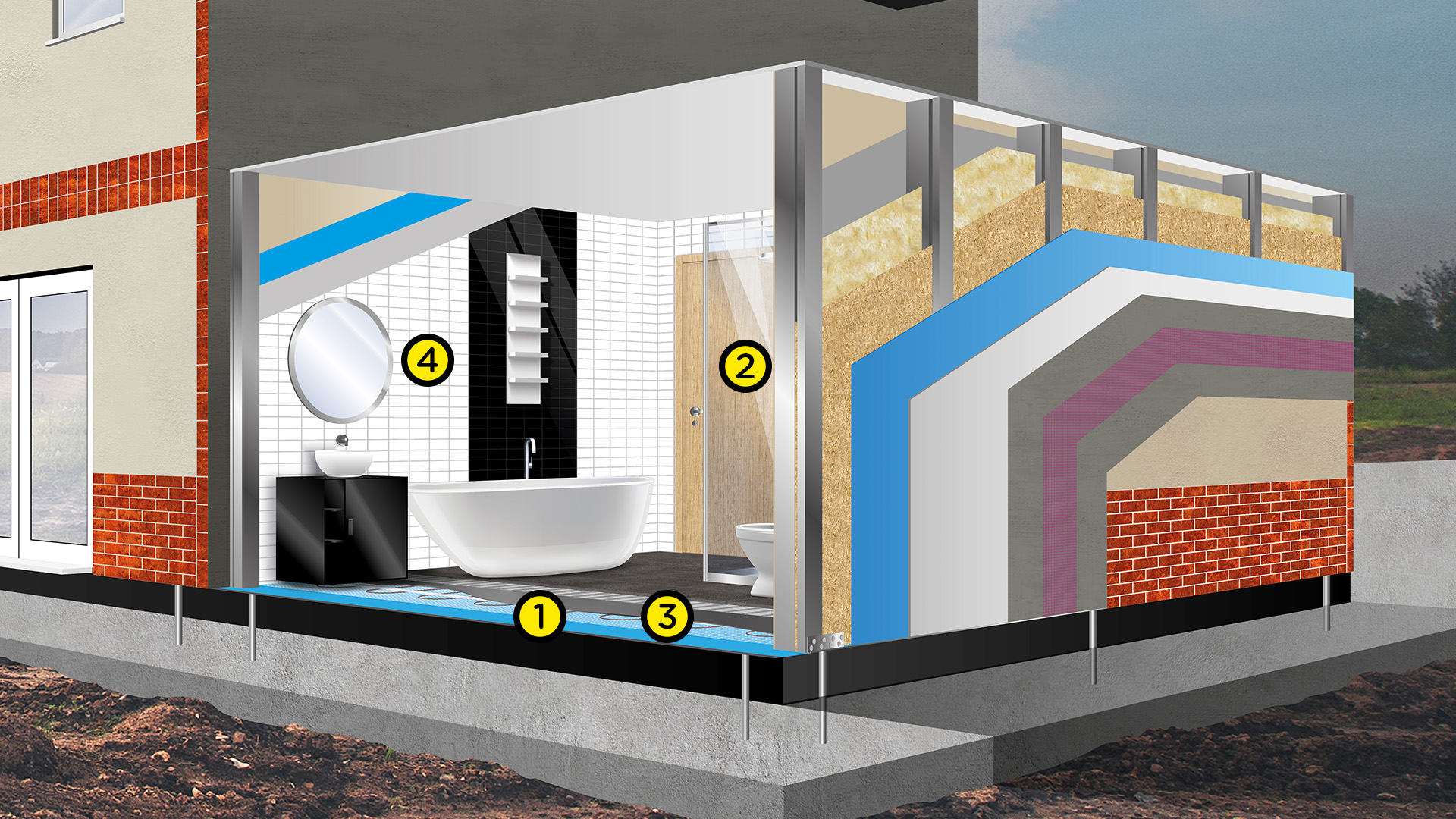
1. Floor levelling screeds
Depending on the construction of the pod a screed may be required to level the floor or encapsulate underfloor heating wires before tiling.
The weberfloor range includes solutions which are:
- Fibre-reinforced for added durability
- Standard or rapid setting
- Suitable for use with underfloor heating or for use with floating floors
2. Tanking system
Code of practice released in July 2018 by the BSI for BS 5385-1 (wall and floor tiling in normal internal conditions) has made demands to tank domestic bathrooms and wet areas with a suitable membrane system before tiling.
webersys protect is a ready-mixed, under-tile tanking kit that acts as a liquid waterproofing membrane to protect water-sensitive substrates.
3. Tile fixing adhesives
Our range of cementitious tile adhesives offers features suitable for modern bathrooms specifying large format tiles on walls and floors.
The weberset range includes solutions that are:
- Flexible – where there may be movement or expansion in the substrate
- Strong – for larger format or heavier tiles
- Rapid set – when you need to start grouting after two hours
4. Tile grout and silicone sealant
Our tile fixing range is complemented with 16 key colours of grout and silicone suitable for modern-styled bathrooms.
Our weberjoint range includes grouts and silicone which are:
- Formulated for lasting protection from mould growth
- Formulated with PURE CLEAN anti-stain technology
- Flexible – suitable for areas that are subject to some movement or vibration
Groundwork solutions
High levels of precision are required when planning groundworks for a volumetric or panel constructed scheme. Weber manufactures a range of precision grouts and bedding mortars to assist in the accurate installation of base plates, drainage channels, communication cables, and more.

Precision grout
MMC projects require a high level of precision and durability, especially when the transfer of dynamic or static loads are required. Our range of cementitious and resin precision grouting products can fulfil this requirement, we have products that are suitable for encapsulating communication cables, general void filling and underpinning. Depending on the project, we can offer solutions which are:
- Standard or fast setting
- Have negligible shrinkage or are shrinkage compensated
- Semi-flexible
- Capable of withstanding high dynamic loads

Bedding mortars
Our range of bedding mortars are ideal for time-sensitive situations such as emergency concrete deck repair, safe installation of access chamber covers or the accurate bedding of drainage channels and ducting. Our range is suitable for small and large scale projects and offers products suitable for a range of requirements:
- Shrinkage compensated
- Standard grade or fast setting
- Durable and chemically-resistant
- Suitable for application to a range of substrates (including concrete, asphalt and stone)
How Weber is contributing to the future of housebuilding

eHome 2.0
Energy House 2.0 is a unique £16m facility at the University of Salford, designed to research and test, in tightly controlled conditions, new ways of powering, heating and insulating homes.
The aim of the research is to make homes more energy efficient and help them meet new standards requiring a significant reduction in carbon emissions for new build homes from 2025.
eHome2 is piloting the use of next-generation construction technologies and uses our innovative weberwall brick system for the external facade of the property.
We're here to support your next MMC project
With a range of support services designed to help you specify the right solutions for your next MMC project including a national applications team which offers onsite support and training, as well as a RIBA-approved CPD.
MMC case studies


Read the full MMC guide

Guide to Renders and Decorative Finished for Modern Methods of Construction (MMC)
This page acts as an introduction to modern methods of construction and the solutions we provide at Weber which can be used in MMC projects, however we also have a more comprehensive guide which goes into more detail about these types of projects and how to deliver them.
Read our guide below or get in touch with us to discuss your project further.